

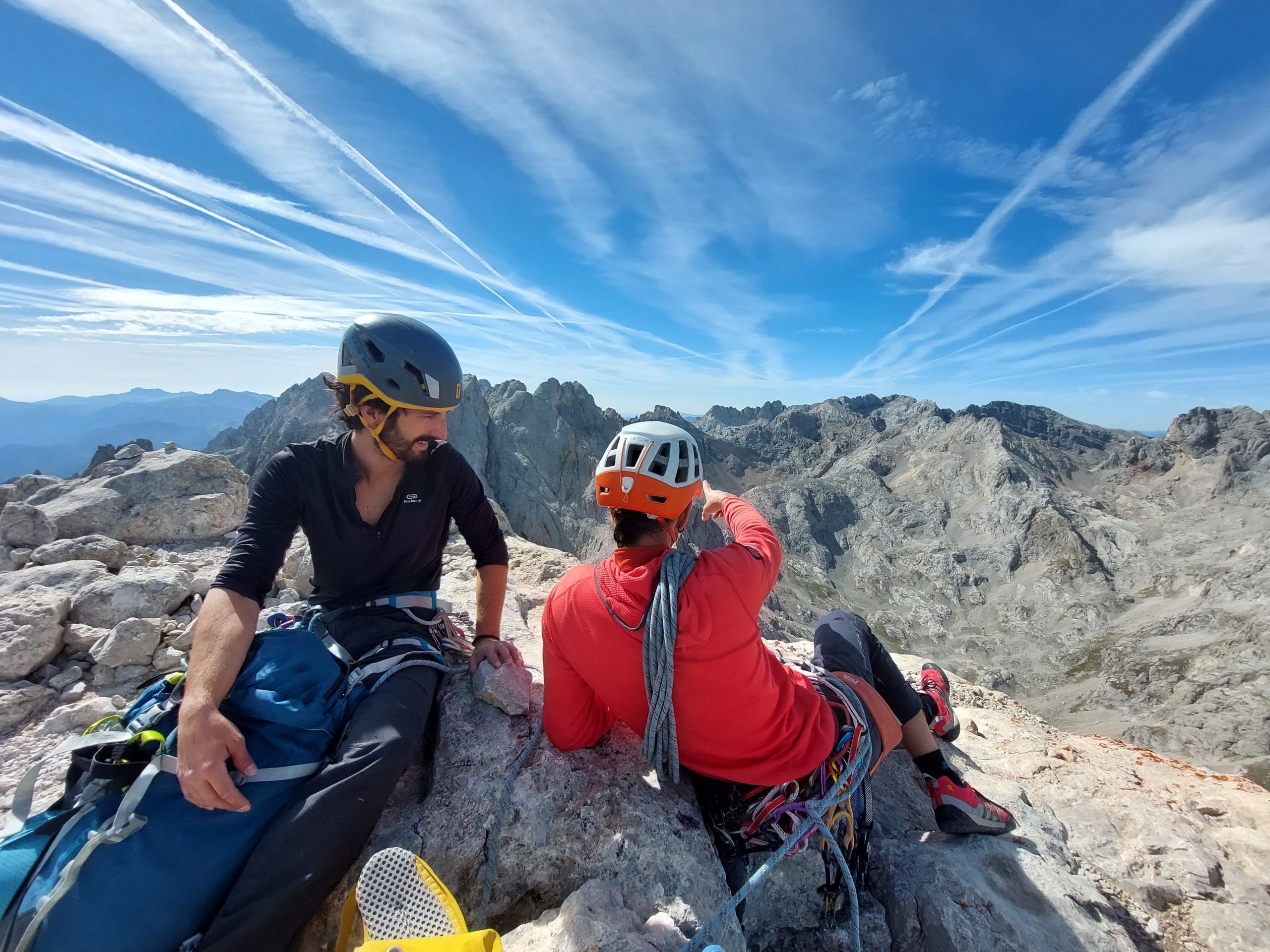
Climbing is booming, no doubt about it. Every day we see more people taking up this sport, or this way of life, depending on who you ask, drawing in athletes and enthusiasts of every age. It’s easy to spot at any climbing gym — our urban schools of climbing — or on any trip to the mountains, where walls that used to feel a little wilder are now crowded with people eager to try something new.
What stands out, though, is that this growth hasn’t been matched by a parallel one. It’s hard not to see a small David versus a towering Goliath in how the sport has expanded, with David being the stunted development and professionalisation of the industry. Let me explain: while climbing is experiencing unprecedented growth, the professionalisation of the sector is, in my humble opinion, being left behind — at risk of being crushed under the weight of its own expansion, like Goliath’s footstep.
Among other things, it seems the working conditions in this field are making things worse. It’s hard to find many professionals who make a living solely from guiding, or from coaching athletes.
Back in the day, when we wanted to earn a bit of extra money doing something that didn’t cost too much, we’d spend the summer as lifeguards, waiters, activity monitors… We were 18, most of us still lived with our parents, but we scraped together “a bit of cash” to pay for our driving licence, go out on weekends, take a trip with friends… Now, the temporary job while we look for something that can support us with dignity seems to be teaching, coaching, or working as a climbing guide.
Almost every professional I know — and by now there are quite a few — makes a living from climbing plus something else, or the other way round. Some recurring patterns I’ve noticed over time (without claiming to cover every case) boil down to three common scenarios:
-
A main job unrelated to climbing + occasional weekends or trips that line up with holiday periods.
This formula seems to work, because doing it sporadically makes the work feel like leisure time. Even while working, one can more or less tell oneself: “I’m doing something I love.” Say it with enough conviction, and you might even start to believe it.
-
Working at a climbing gym (employed) + teaching courses or guiding in whatever gaps the main job leaves free.
By the end of the month, this formula can almost cover your rent, but the trade-off is having little to no free time. Of course, as with the previous case, since we love what we do, free time doesn’t feel so essential either.
-
Full-time courses, guiding, or coaching,
(the unshakeable freelancer) + community manager/influencer.
This one can turn into a devoted payer of generous sums to Instagram, so the algorithm ranks us well and we can put ourselves, and our private lives, on display in the name of attracting more potential clients.
In this last category you find a bit of everything, from genuinely good professionals who’ve chosen — or not — the showcase of new technologies and still live off their good work and word of mouth, to true peddlers of smoke and mirrors.
But generally speaking, the best professionals rarely have the time, or the desire, to spend hours a day handing out advice online about how to improve your life through climbing. The climbing guru is an increasingly common figure on social media, and — surprise — it doesn’t signal a more professionalised industry.
In the second category, we find that whole group of professionals fighting to earn a living exclusively through the practice of climbing instruction, mostly as employees, but struggling to balance their free time, their income and expenses, and overall stability. This is easy to observe at climbing centres, where finding a good climbing professional who’s worked at the same centre for two years is rare, five years rarer still, and finding one who’s stayed over a decade might mean you’ve stumbled on a “rare bird,” an endangered species. Take care of them, hold on to them, because we can’t know how much longer they’ll survive.
It turns out free time isn’t so irrelevant after all.
Which brings us to why we so often find trainees, or people with relatively little experience, teaching courses, running the training groups at a gym, or guiding on weekends for little pay, often without any qualification. As soon as they can, they’ll move on — maybe to a more stable line of work, maybe toward becoming a full-time guide, though that’s another story for another day, since we also find people of questionable vocation and even less preparation heading out to guide, charging prices that match the level of service they offer.
Guiding isn’t something you learn overnight. It takes many hours logged as an athlete first, before you can train as a good professional — but as I said, that’s not what concerns us here.
One of the problems that comes out of all this is that it has a direct impact on the professionalisation of the climbing industry — or, put more accurately, on the lack of it.
Fundamentally, the message we end up sending our climbing instructors, at best, is to go find other jobs to make ends meet — which inevitably takes value and importance away from our profession, and pushes out the ones gaining the most experience toward other lines of work.
Some might argue there’s always the option of climbing the ladder, so to speak, within the profession or within a given company, but that isn’t always a good thing. What I mean is: an excellent instructor doesn’t necessarily make a great coordinator, or a great trainer, and having to “move up” into a role overseeing a gym’s programme development — a role in which almost none of the skills that made them an excellent professional apply — doesn’t look much like progress. Over the course of my career I’ve come across people who, to everyone’s misfortune, ended up in a position they were simply not competent for.
I’ve had the fortune — or misfortune, depending how you look at it — of devoting myself wholeheartedly to something I love. It has given me extraordinary moments, but I’m not so naive as to look back and pretend that all of us in this profession haven’t, sooner or later, found our teaching vocation and our love for climbing colliding with a nomadic way of life, short on stability and, generally, with precarious working conditions poorly matched to the responsibility we carry.
Sharing climbing, accompanying athletes and future professionals through their training, through the progress of their careers, toward their goals, reaching summits together, flying free — all of this brings back so many exhilarating moments that I almost, almost forget at times that this has been, and still is, a profession for me and for many of my colleagues and friends. A profession, it must be said, that is extremely uncertain. And the more we love something, the easier it becomes to make sacrifices in its name — and, paradoxically, to make its own development and professionalisation harder in the process.
I’d like to invite fellow professionals in the climbing world to a shared exercise in reflection, to help define some sustainable terms we can all stay afloat with. I’d also invite athletes and gym users, people who are coached or would like to be, and really anyone who might end up connected to a climbing professional, to reflect on this too — especially if what you want is a good professional in charge of your safety and wellbeing, or if you think these aren’t important enough questions to ask.
If you’re interested in doing an activity, take a look at these destinations to see if any of them catch your eye here.
Prefer to pitch me your own idea? Write to me here.
If you think what you’ve just read might be worth sharing with someone else, please do — together we can help push this industry toward the professionalisation it deserves.
